Our Location
Palakkad, Kerala India

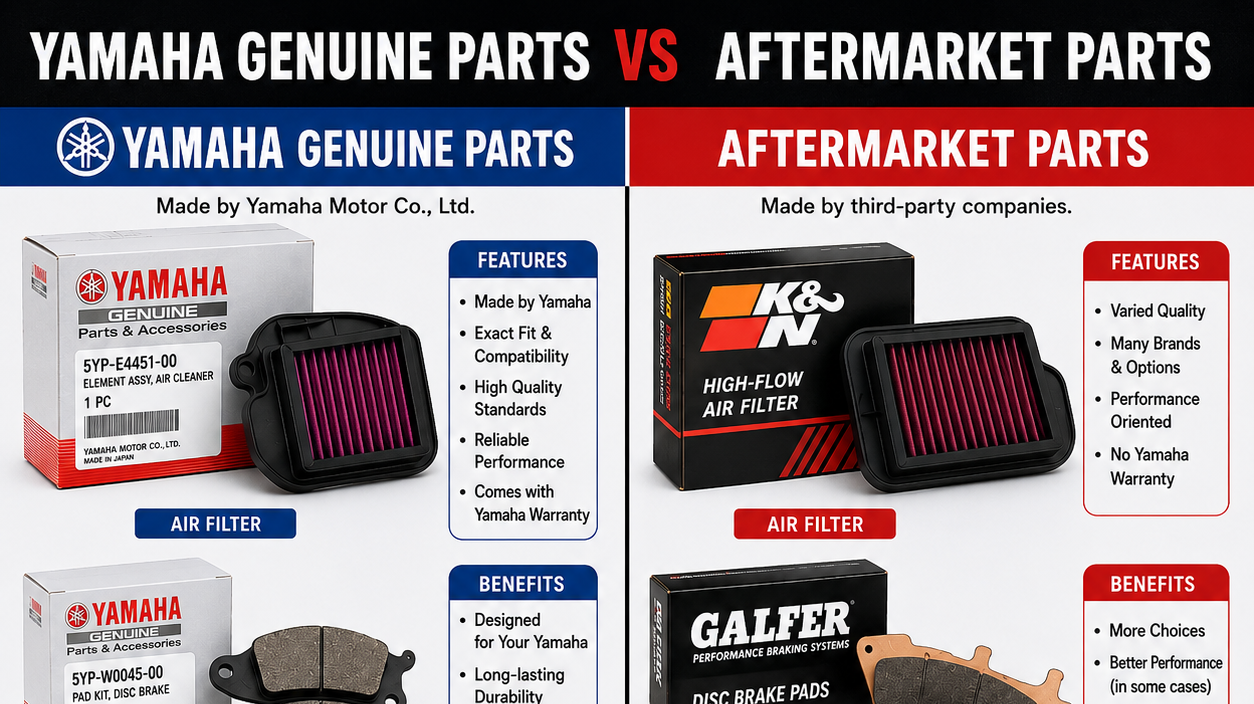
It started on a Tuesday morning. My Yamaha rx-100 making sound it had no business making a faint metallic rattle somewhere deep in the engine. I took it to my usual mechanic, who’s been fixing bikes for fifteen years. He looked at me and said simply brake pads are gone I’ll fix it.
“Genuine or aftermarket” he asked wiping hands-on cloth both were available the price gap? Nearly double I stood there, wallet in one hand, pride in the other and realized I had no real idea what the right answer was.
So, I stared digging. Talked to mechanics checked forums. Put my own money on the line, multiple times and here’s what I found out the honest, sometimes inconvenient truth about genuine Yamaha parts versus aftermarket alternatives.
“The cheap part costs 400. The second cheap parts costs 400. The third part costs the engine”
Let’s be direct genuine Yamaha parts are built to exact factory tolerances. Every dimension every alloy composition, every heat treatment it’s all engineered specifically for your engine. Yamaha designs the part and the machine together that’s not marketing. That’s physics.
Some aftermarket manufacturers brands like minda or uno minda come close. They’ve invested in tooling, quality checks and material sourcing. But plenty of cheaper alternative floating in the market? Different story. The metal is softer. The tolerances are looser. Sometimes by fractions of a millimetre, which sound insignificant until your brake pad wears unevenly and starts pulling right.
It’s not always visible that’s the tricky part. The part looks identical in your hand. You bolt it on. Bike runs fine. For maybe three months. Then things start going slightly wrong. In way that are very hard to trace back to that one cheap component you replaced eight rides ago.
Here’s what most people don’t realize until it’s too late. Yamaha’s warranty the one that covers manufacturing defects for the first two years ahs a condition buried quietly in the terms. If a non-genuine part causes or contributes to a failure the warranty claim gets complicated fast.
A friend of mine replaced his rx100 oil filter with a cheap aftermarket unit to save 180 three months later, he had an oil pressure issue. The Yamaha service center wasn’t unreasonable but when they traced the issue back to the filter the conversation changed, he paid out of pocket for a repair that would have cost him nothing under warranty.
The calculus here isn’t hard. If your bike is under warranty especially in the first-year genuine parts aren’t optional they’re the entire point you’re paying for coverage and using cheap parts is quietly signing away that coverage without knowing it.
After warranty expires? The calculation shifts. But even than it’s not a straight swap.
Under warranty always genuine after warranty genuine for engine internals, baking and electrical aftermarket acceptable for cosmetics, filters and rubber components if you buy a reputable brand and your mechanic confirms fitment.
people choose aftermarket to save money. Thet’s reasonable a genuine Yamaha brake pad might cost 800-1,200 a decent aftermarket pad might be 350-500 on a tight budget, that gap is real.
Genuine parts typically last longer 20 to 40 percent longer in many cases, based on the wear patterns mechanics routinely observe. So that “cheaper” pad replaced more often, over three replacement cycles might actually cost you more than two genuine pads would have. And that’s before factoring in the mechanic’s labour, which you’re paying every time.
Then there’s the resale question. A well-maintained Yamaha with genuine service history and documented genuine parts commands a noticeably higher price in the used market. Buyers can tell or at least the smart ones can and that premium, even if it’s just a few thousand rupees, often offsets years of cost different in parts.
There’s also something harder to quantify. Trust when you know exactly what’s in your machine you ride differently. You don’t hesitate at 90 kmph. You don’t second-guess the breaks on a wet road. That confidence has value it just doesn’t show up on a spreadsheet.
It’s not binary that’s the honest answer. Anyone who tells you always genuine or aftermarket is fine without knowing your specific situation is giving you ideology not advice.
Safety critical and engine internal parts brakes, clutch, piston, gaskets bearings use genuine every time. The margin for error is zero. Cosmetic and wear items mirrors, plastic panels, air filters, spark plugs from a reputable brand aftermarket is often fine and the saving are real. Electrical? Tread carefully. A bad CDI or rectifier can cause cascading damage that costs ten times the part itself.