Our Location
Palakkad, Kerala India

Tell you what. Most riders don’t think about grease until something starts squeaking. Or grinding. Or worse, goes quiet and locks up.
A mechanic in Palakkad once showed me a wheel bearing off an old RX100. Dry. Rust coloured. The owner had topped it up with “some grease from the shop” two years back. Which grease? Nobody remembered. That’s the problem right there.
Grease isn’t just grease. Let’s fix that.
What grease actually is
Simple. Base oil, a thickener, and additives. The oil does the lubricating. The thickener holds the oil in place like a sponge. Additives fight rust, wear and heat.
Change the thickener and you change everything. Heat tolerance, water resistance, how long it stays put. So, the type matters. A lot.
The main types you’ll meet
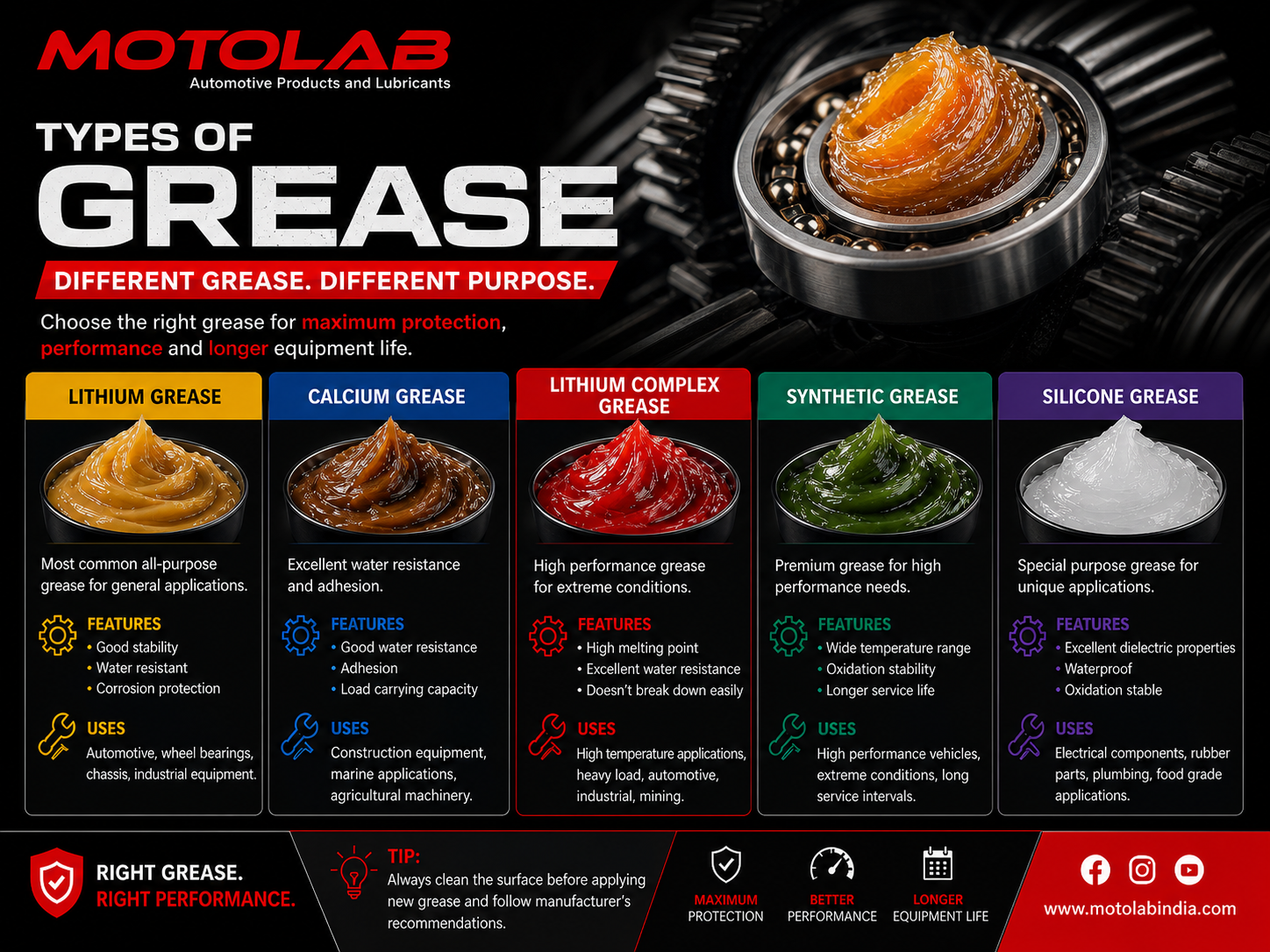
Lithium grease. The old workhorse. Cheap, easy to find, works fine for general chassis points. Good for light-duty stuff like cable ends and pivot pins. But water? It washes out faster than you’d like, especially in our monsoons.
Lithium complex grease. Lithium’s tougher cousin. Handles higher heat and heavier loads. Most wheel bearings on motorcycles are happy with this. If you only want one tub on your shelf, this is usually the one.
Calcium sulfonate grease. The rain fighter. It shrugs off water, resists rust, and sticks to metal like it paid rent. For Kerala riding, coastal air, wet roads, river crossings, it’s a strong pick. Costs more. Worth it.
Moly grease (molybdenum disulfide). Dark grey, almost black. The moly particles protect metal when the oil film gets squeezed out under heavy load. Use it on CV joints, splines, and high-pressure sliding parts. Not for every bearing though. Some sealed bearings don’t like it.
Synthetic / PTFE grease. Slippery, clean, stable across big temperature swings. Good for brake pivots, throttle mechanisms and anywhere you want smooth feel. Pricey, yes. A little goes far.
Copper grease. Anti-seize more than lubricant. Goes on exhaust studs, spark plug threads, bolts that see serious heat. Never put it inside a bearing. Never.
Silicone grease. Rubber and plastic safe. Use it on O-rings, seals, and brake piston boots. Wont damage the rubber, which petroleum grease often does.
The number on the tub
See “NLGI 2” printed somewhere? That’s the thickness grade. Think of it like peanut butter.
Most motorcycle jobs are NLGI 2. Done.
Match the grease to the job
Here a rough map for your bike:
| Wheel bearings | Lithium complex or calcium sulfonate |
| Steering head bearings | Lithium complex, water-resistant preferred |
| Swingarm and linkage bushings | Calcium sulfonate or moly-lithium |
| Throttle and clutch cable ends | Lithium or PTFE |
| Brake pivots, lever pins | PTFE or silicone |
| Brake piston seals | Silicone only, check what your manual says |
| Exhaust studs, plug threads | Copper anti-seize |
| Speedo drive, kick lever shaft | Lithium complex |
Chain? That’s not grease territory. Use proper chain lube. Different job.
Kerala makes it harder
Six months of heat. Three months of rain. Salt air near the coast. Grease here works overtime.
Water is the real killer. Once it gets past a seal, plain lithium turns to a creamy mess, and creamy mess equal’s rust. So, if you ride through monsoon, lean towards water-resistant grease. Calcium sulfonate or a good lithium complex with rust inhibitors.
And check your seals. Best grease in the world can’t help a cracked seal.
Vintage RX bikes need extra care
Your RX100 or RX135 is decades old. Old bearings, old seals, old clearances. Don’t just pack them full of the stickiest stuff you can find. Overfilling a bearing makes it run hot and churns the grease. Fill about one third to half of the bearing cavity. Thats it.
Clean the old grease out first. Properly. Mixing two different greases can break both down, since some thickeners don’t get along. When in doubt, wipe it all out and start fresh.
Quick mistakes to avoid
So, which one?
If you want the short answer, here it is. One good lithium complex or calcium sulfonate NLGI 2 for bearings and general use. One small tube of silicone for rubber parts. One copper anti-seize for hot bolts. Three things. That covers nearly everything on a street bike.
Grease is cheap compared to a seized bearing. Spend the extra fifty rupees. Your bike will thank you, quietly, for years.