Our Location
Palakkad, Kerala India

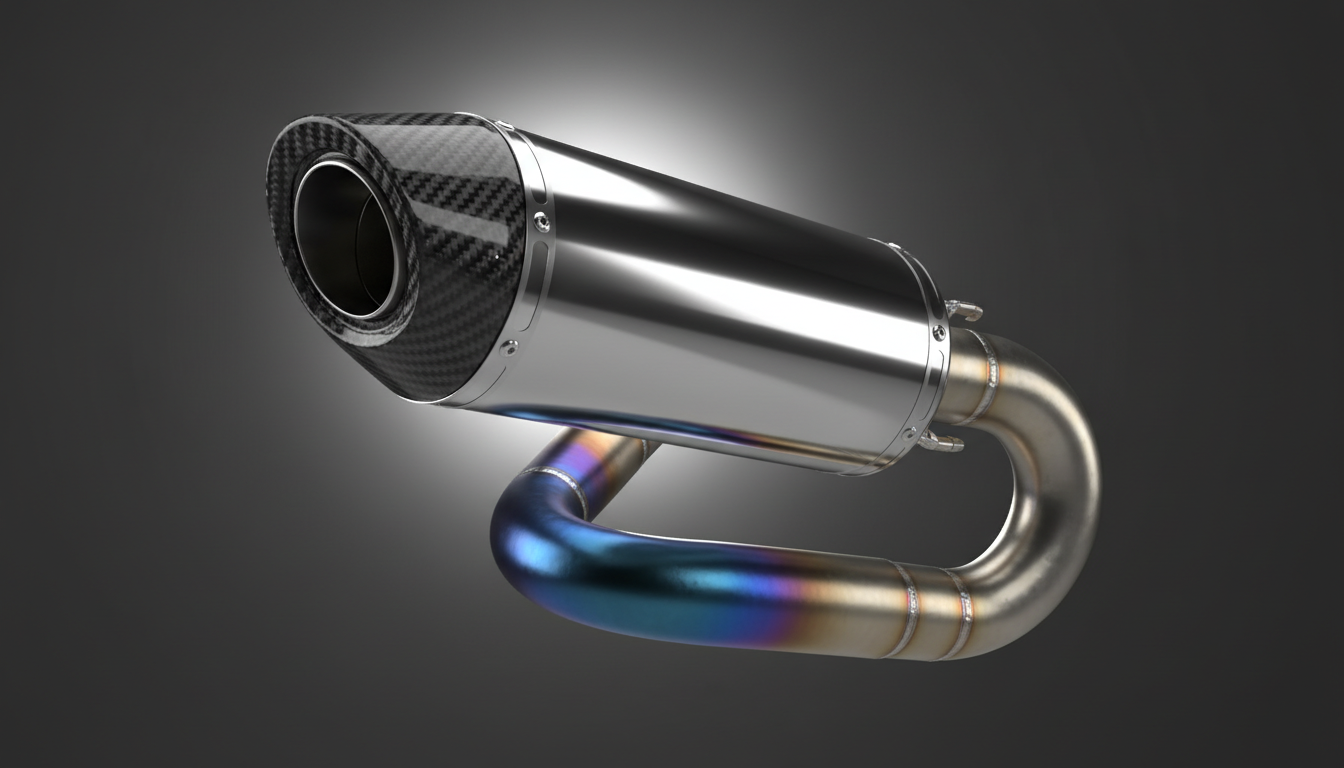
Few modifications are more tempting — or more misunderstood — than an aftermarket exhaust. The promise is seductive: more power, less weight, a soundtrack that makes the hairs on your arms stand up. And the aftermarket delivers on all of that, if you know what you’re actually buying. But the exhaust market is also full of cheap, badly-engineered units that sound great for about 10 minutes before they corrode, crack at the weld points, or detune your fueling so badly you lose more than you gain.
This guide is for the rider who wants to understand the engineering behind exhaust systems, make an informed purchasing decision, and get the most out of the upgrade.
Your engine is essentially an air pump. It draws in air and fuel, combusts the mixture, and expels the exhaust gases. The speed and efficiency with which those gases exit directly affects how quickly fresh charge enters — which is why exhaust design has such a profound effect on power output.
The key phenomenon is scavenging: the exhaust pulse from one cylinder creates a low-pressure wave that travels back up the header pipe and literally helps pull exhaust gases from the combustion chamber, improving cylinder scavenging. Get the header pipe diameter and length right for your engine’s specific RPM range and displacement, and you amplify this effect at the RPM where you want power most.
“A slip-on makes you smile. A full system with a remap makes your bike a fundamentally different machine.”
A slip-on replaces only the muffler section — everything from the header pipes to the mid-pipe remains stock. Installation is straightforward (30–45 minutes with basic tools), cost is lower, and the sound improvement can be dramatic. Power gains, however, are modest: expect 1–3 hp on most bikes, primarily in the mid-to-upper RPM range where the stock muffler was most restrictive. For riders primarily after sound and aesthetics with a weight saving, a quality slip-on is the right choice.
A full system replaces everything — headers, mid-pipe, and muffler. This is where genuine power gains live. A well-engineered full system, paired with a proper ECU remap, can liberate 8–15 hp on middleweight bikes, and more on litre-class machines. It also delivers the most significant weight reduction: OEM exhausts on bikes like the Kawasaki Z900 or Triumph Street Triple weigh 8–12 kg; a full titanium aftermarket system can bring that down to under 4 kg.
Slip-On Weight Saving
1–3 kg
Full System Weight Saving
4–9 kg
Slip-On Power Gain
1–3 hp
Full System + Remap
8–15 hp
Stock OEM exhausts are typically mild steel with a coating. Cheap aftermarket units also use mild steel. It’s heavy, prone to rust, and not a material you want in an aftermarket performance exhaust. Avoid.
304 stainless is the baseline for quality aftermarket headers. Corrosion-resistant, durable, and capable of withstanding sustained high temperatures. 321 stainless adds titanium stabilisers that make it more resistant to heat cycling fatigue — it’s the spec used in motorsport-grade systems. Akrapovič’s entry-level steel systems, SC Project, and Arrow all use high-grade stainless for their header sections.
Titanium offers the best strength-to-weight ratio of any exhaust material — roughly 45% lighter than stainless at equivalent wall thickness, with superior heat resistance. A titanium full system is a noticeable dynamic change to your bike, not just a performance one. The weight reduction improves mass centralisation and reduces unsprung weight effects. Quality titanium systems command a premium — expect to pay ₹60,000–₹1,50,000 for top-tier units — but for track-focused riders, it’s a worthwhile investment.
Carbon fibre is used almost exclusively for muffler canisters, not headers (it can’t handle the temperatures at the header). A carbon can is primarily aesthetic and weight-focused — it looks extraordinary and sheds 500g–1kg over an equivalent steel muffler. Pair a titanium header with a carbon canister and you have one of the lightest, best-looking exhaust setups available.
Modern motorcycles run closed-loop fuel injection managed by an ECU that’s tuned for the stock exhaust. When you increase exhaust flow — especially with a full system — you change the exhaust backpressure dynamics the ECU was mapped around. The result without remapping: lean fuelling conditions, particularly in the mid-range, which can cause flat spots, increased heat, and in extreme cases, engine damage over time.
A full remap via Power Commander, Bazzaz, or ECU flashing is mandatory if you’re fitting a full system. Even with a slip-on, an autotune kit is strongly recommended — particularly for fuel-injected bikes that were already running lean from the factory (many modern bikes are, to meet emissions standards).
⚠️
Important: Running an aftermarket exhaust on a public road without the required homologation approval is a legal grey area in India. Ensure any exhaust you purchase is compliant with applicable noise and emissions regulations to avoid issues at checkpoints or during registration renewals.
Header bolts on hot engines are notoriously difficult. Before installation, clean all threads with a wire brush and apply copper anti-seize compound. Torque header bolts to spec in a crossing pattern — not sequentially — to ensure even gasket seating. New gaskets are not optional; reusing old header gaskets is how you end up with exhaust leaks that ruin your fuelling and sound worse than the stock pipe.
Allow 500 km of break-in for new stainless or titanium systems — the metal needs heat cycling to stabilise welds and expansion points. You’ll often see a slight colour change on titanium headers during this period (the characteristic blue-purple heat discolouration). That’s not damage — it’s physics, and it looks absolutely stunning.