Our Location
Palakkad, Kerala India

Let me start with a confession. I used to think engine oil was just oil. Something slippery. Something that keeps metal from scraping against metal. And sure, that’s basically true. But the deeper you go, the more you realize how much chemistry is happening inside am engine every single time you turn the key.
Conventional oils? They come straight from crude. Refined sure but still fundamentally a mixture of hydrocarbon that nature put together. Synthetic oils are different. Entirely different. They’re engineered from the ground up at a molecular level designed to do specific jobs in specific conditions
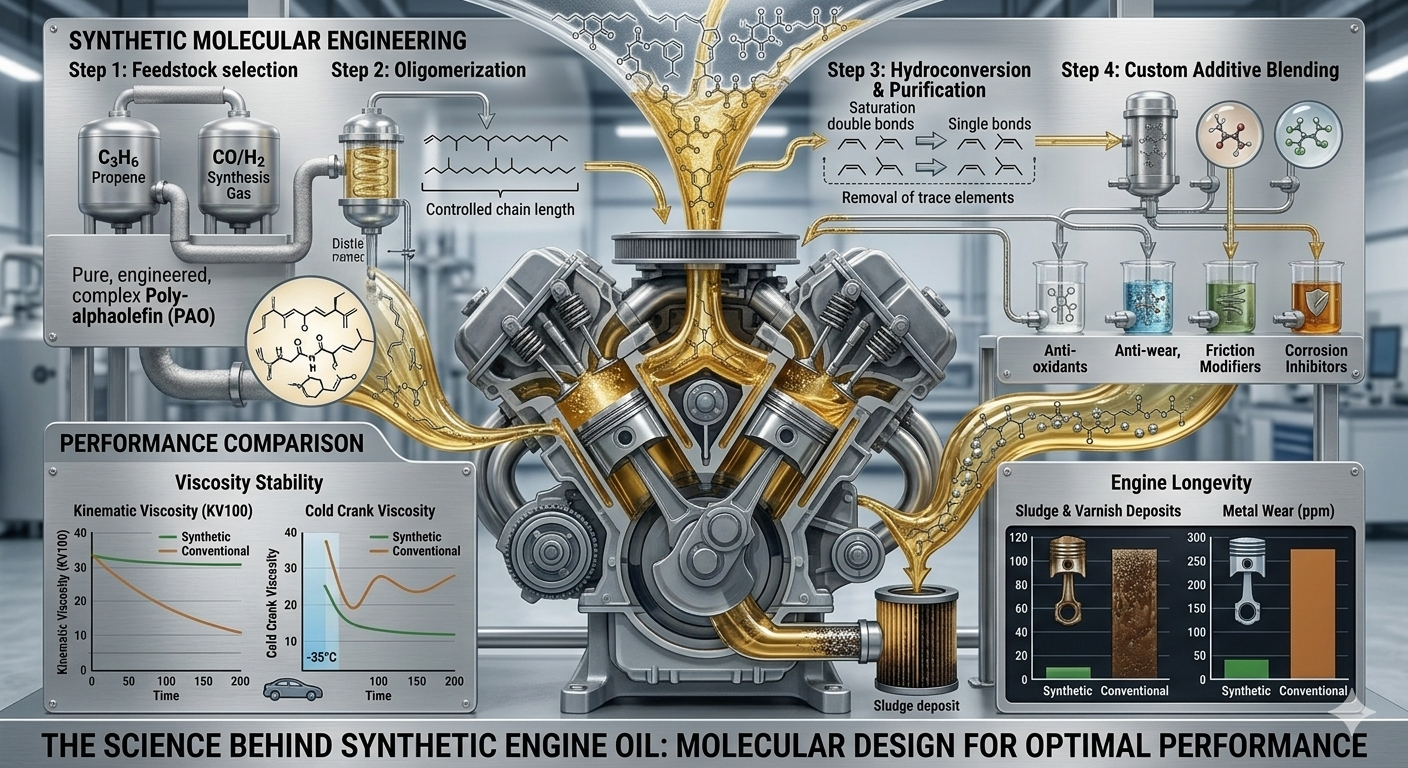
The backbone of most synthetic oils is something called polyalphaolefin, or PAO don’t let the name intimidate you. Essentially, it’s a chain of carbon and hydrogen atoms that chemistry build to order. Unlike crude-derived base stocks which contain all sorts of impurities and irregular molecular shapes, PAO molecular are uniform. Consistent predictable.
When molecular are uniform, they slide past each other more easily. Less friction less heat less wear. The engine doesn’t have to work as hard. And over time, that adds up to an engine that lasts significantly longer.
Here’s something that trips people up. Oil has to do two very different jobs depending on temperature. On a cold morning, it needs to flow quickly you want it reaching your engine’s moving parts before they grind against each other on start-up. On a blistering summer day with the engine sunning hot, it needs to stay thick enough to actually form a protective film between metal surfaces.
Conventional oils struggle with this. They thin out at high temperature. They thicken in the cold it’s a genuine compromise.
Viscosity index (VI) measures how much a fluid viscosity change with temperature. Higher VI= more stable across a range. Conventional mineral oils typically sit around VI 90-110. Quality synthetic PAOs regularly reach VI 130-160 or higher a significant jump in terminal stability.
Synthetics handle this tension far better. Their uniform molecular structure means they don’t fall apart under heat or stiffen unpredictably in the cold. A good full-synthetic rated OW-40 can flow at temperature as low as 40c while still protecting at sustained operating temps above 130c that range? Nearly impossible with conventional oil.
“The goal was never just lubrication. It was engineering a fluid the behaves exactly the same way, regardless of what you throw at it.”
Raw base stock even perfect PAO isn’t enough on its own. Modern engine oils are complex formulation. The base oil might be only 75-80% of what’s in that container. The rest? An additive package doing a whole lot of heavy lifting.
Slow down the chemical breakdown of oil molecules under heat and oxygen exposure. Without them, oil oxidises and turns to sludge fast.
Keep combustion by-products soot, acids, carbon particles suspended in the oil so they can be trapped by the filter instead od depositing on engine internals.
Zinc dialkyldithiophosphate is the classic example. Forms a sacrificial film on metal surfaces under extreme pressure conditions.
Long polymer chains that expend in heat and contract in cold, helping maintain consistent viscosity across temperature rangers.
PAO isn’t the only synthetic base stock. Ester based oils are increasingly common, especially in high performance and motorsport and application esters are formed through a chemical reaction between acids and alcohols and they have alone unique properties that PAOs alone can’t match.
Because ester is polar, they’re naturally attracted to metal surfaces. They cling. Where PAO molecules float in suspension, ester molecular actively adhere to engine components creating a more persistent film even when the engine’s been sitting idle for a while. Cold start protection, in particular, benefits significantly from ester content.
This is why many premium full-synthetic oils use a blend PAO for thermal stability and viscosity performance esters for surface adhesion and boundary lubrication. The two genuinely complement each other in ways that neither can achieve alone.
This is the question isn’t it. Is the premium price worth it or is it just marketing?
The honest answer it depends what you’re doing. For a car driven gently changed every 5,000 km in a moderate climate conventional oil does the job it always has.
But push things harder? Longer drains turbocharged engines cold climates high mileage motors performance driving these are the conditions where synthetic oil’s properties translate directly into measuring benefits less wear, cleaner internals lower operating temperature and extended drain intervals that can easily offset the higher cost per litre.
The synthetic oil market is noisy claims pile up “ester technology” “nano additives.” “Molecularly engineered.” Some of it means something. Some of it is genuinely just packaging.
What actually matters base oil quality additive package integrity and whether the oil meets the specifications your engine manufacturer actually calls for API rating, ACEA classifications and manufacturer specific approvals are the real benchmarks not front-of-bottle superlatives.